
First, We Must Plant the Water
Solutions to the Water Crisis on the East Cape of Baja California Sur, Mexico
By: Joy E. Stocke & Paulina Godoy Aguilar
“…it dreamed its seeds fell to the ground and turned into other trees
and other dreams that grew inside and outside us…
The Tree ”
The mid-summer heat hovers near 35 degrees Celsius (95 degrees Fahrenheit) when we arrive at the entrance to Rancho La Piedra to meet owner and water conservation pioneer Monica Robinson Bours. Here, in the foothills of the Sierra La Laguna Mountains, the terrain has gone brown in response to the lack of rain that is the summer norm.
When Paulina Godoy Aguilar, Program Director for the Baja Coastal Institute (BCI); Frida Sanchez, Luna, Education and Research Assistant, and I arrive from La Paz, we see beyond the driveway trees heavy with fruit, irrigated with water collected and harvested during the brief rainy season and stored in a cistern that Robinson Bours and her team have dug as part of a water-recapture on the property.
In 2015, as unchecked development and critical depletion of the region’s aquifer threatened the region’s water supply, Bours, who holds a degree in biochemistry, sought out and partnered with local ranchers and experts in water and soil conservation to turn Rancho La Piedra into a working laboratory and hands-on teaching institute to conserve and reuse the region’s most precious resource.
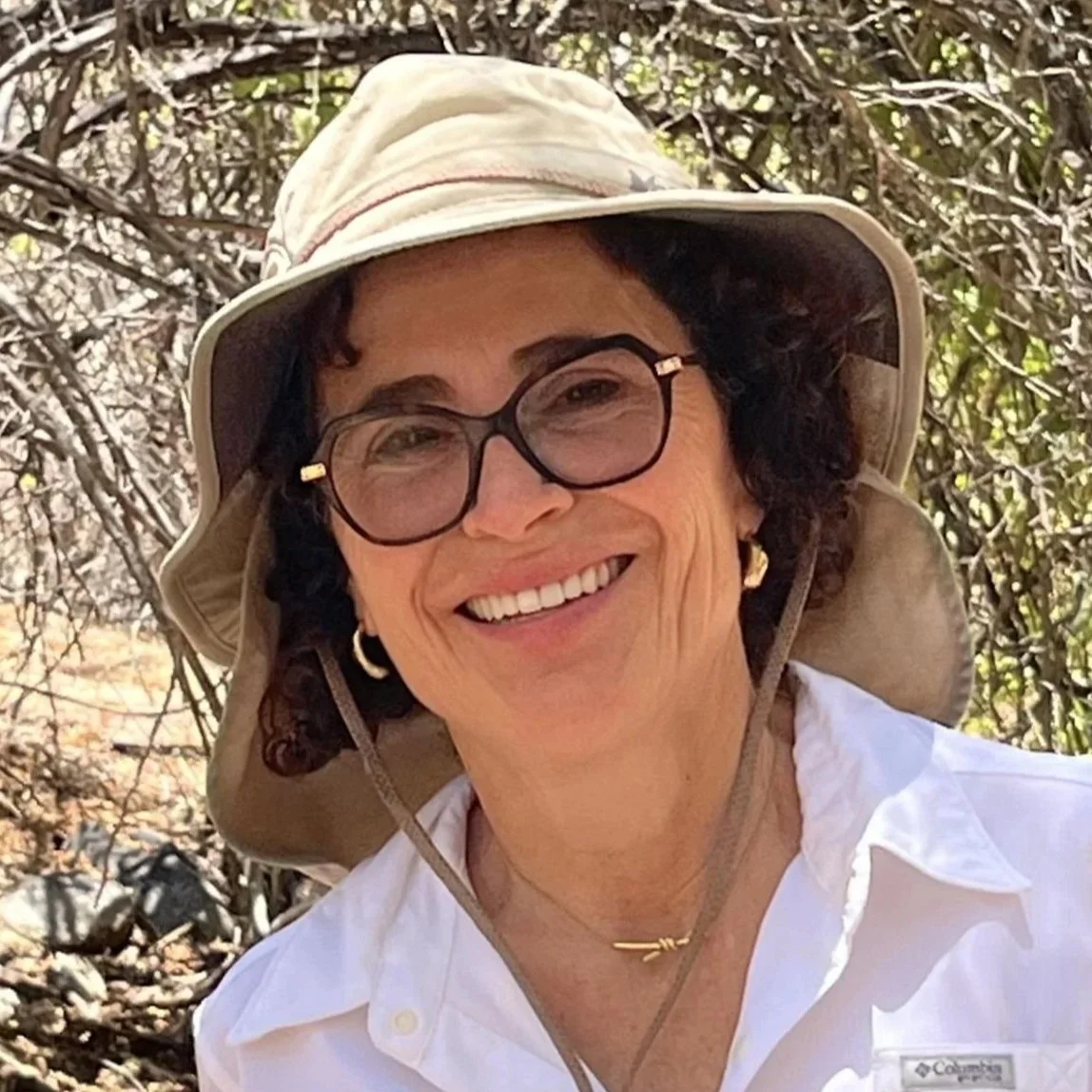
Monica Robinson Bours
From 2010 to 2020, through overexploitation of the region’s aquifers due to tourism, urbanization and population growth, water scarcity increased by 25.3%. ( 1 ) Developments constantly threaten the fragile ecosystem and tap into aquifers that weren’t meant to handle heavy use.
“Once the aquifers are depleted, they’ll need thousands of years to fully, if ever, recharge,” says Robinson Bours. “If growth continues at the current pace, by 2040, building projects including resorts will outstrip the region’s ability to recharge its aquifers.”
The facts are sobering. An average hotel room uses 1,000 liters (265 gallons) of water per day. From January through July when the region receives little or no rainfall, an 18-hole golf course consumes between 1.5 and 2 million liters (397,000 gallons) of water per day. The same amount of water is used by 3,533 people or 821 homes per year.
“This region of magnificent beauty has important natural reserves such as the Cabo Pulmo National Park and the Sierra la Laguna mountains which are both World Heritage Sites. Currently, the accelerated growth in real estate increases the demand for the Eastern Cape’s most precious resource: water.”
Godoy Aguilar and the team at BCI work directly with Rancho La Piedra, educators, local officials, and organizations who are teaching the techniques Bours has put into practice to students from the nearby pueblos of Los Planes, El Sargento, Cardonal, La Ribera, Miraflores, San Antonio, Santiago, Cabo Pulmo, and Los Barriles. All of those communities face severe water shortages and through BCI’s partnership with Bours and her team, the area’s students are bringing water conservation directly into their schools, homes, and public spaces. “We live in communities that are losing their water supplies, running out of water, or becoming unable to afford to pay for their daily water needs,” says Godoy Aguilar, “but we have the tools to create solutions.”
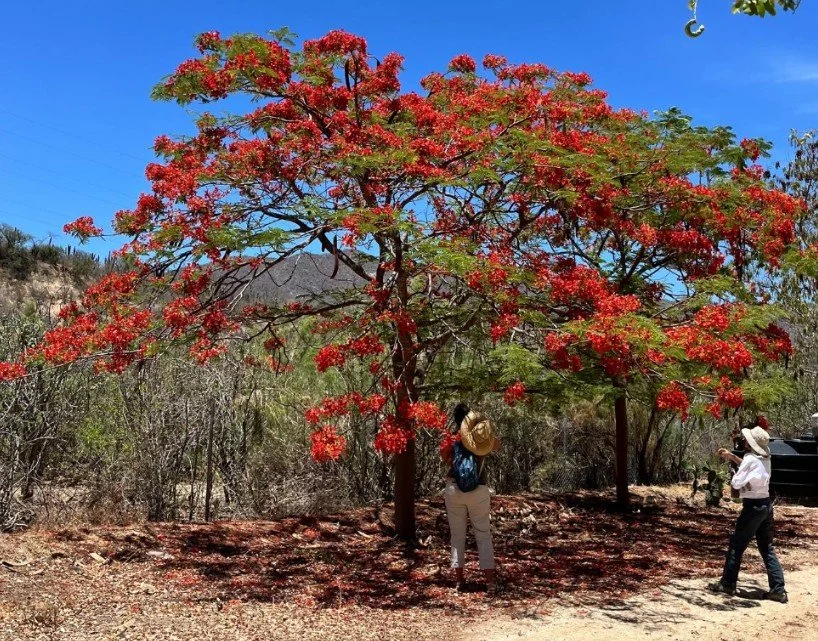
Tabachin Tree - Monica Robinson Bours and Paulina Godoy Aguilar
The Ancient Practice of Capturing Water Through Gabions
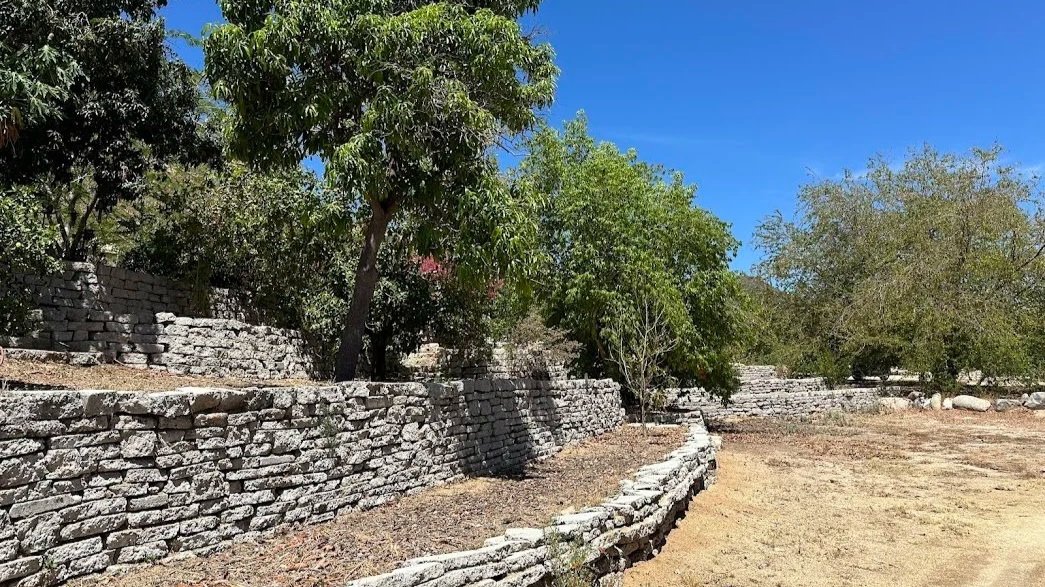
At Rancho La Piedra, restoration begins with stone and gravity. Workers construct what are known as gabion staircases—a series of rock-filled wire baskets placed strategically along the channel of a seasonal stream. Rather than attempting to stop the powerful surge of rainwater that arrives during Baja’s summer storms, the gabions gently slow its passage down the mountain. Each step in the staircase captures sediment carried by the runoff, gradually rebuilding the soil that erosion once stripped away. Over time, the steps begin to fill with sand, organic matter, and moisture. Native grasses and shrubs take hold, wildlife returns, and the land slowly transforms from a drainage channel into a living sponge—holding precious water in the watershed instead of letting it rush uselessly down the mountain.
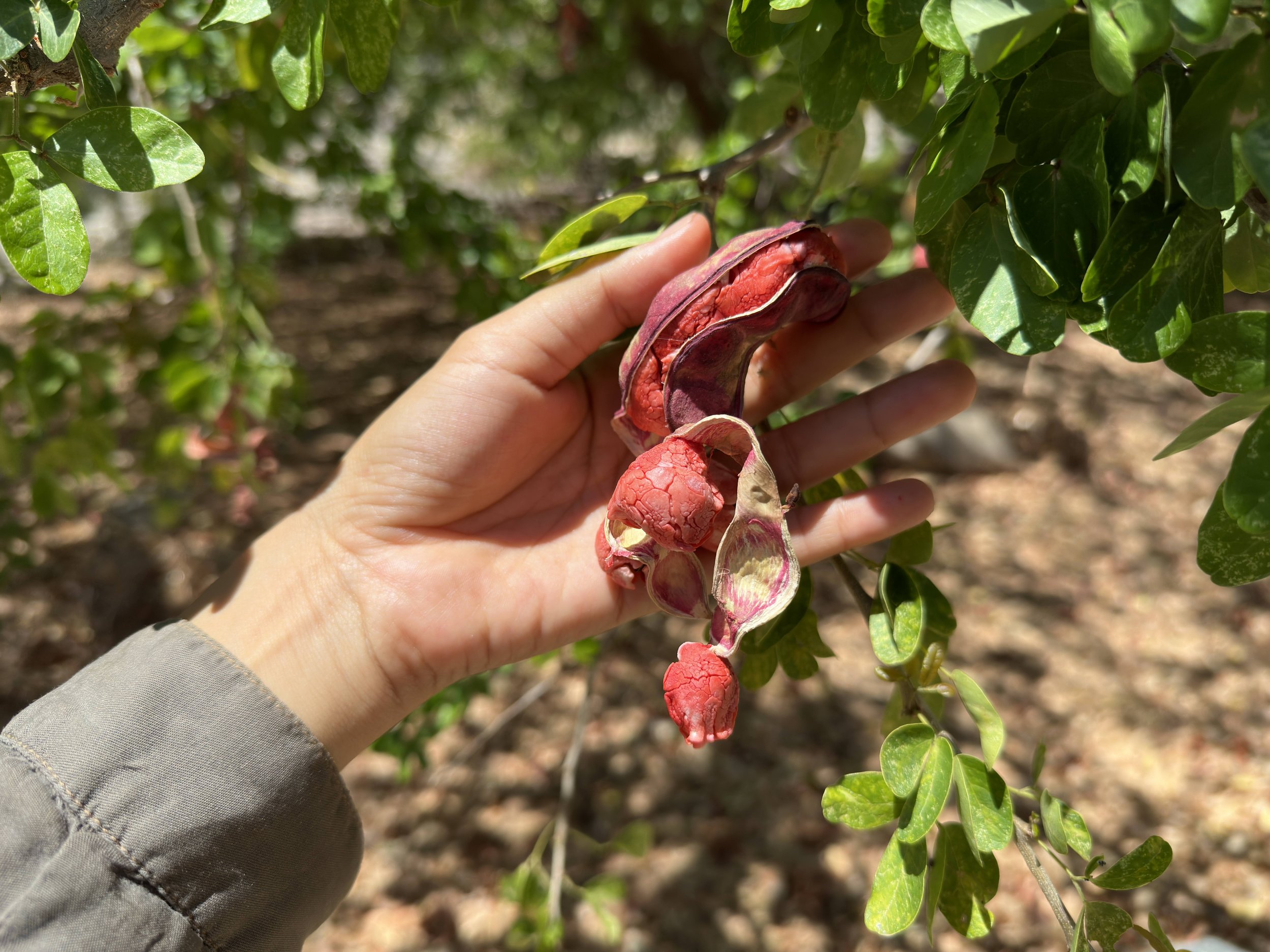
Robinson Bours shares the history of Rancho La Piedra and that of her neighbors. “Because ranchers had no access other than the water available on their land, people who have lived here for generations had no choice but to conserve water and maximize the value of limited resources,” she says. “Many of these techniques, such as digging cisterns and building gabions to slow the flow of water, have been in use since the time of the Aztecs. And those techniques can be used on a large or small scale.”
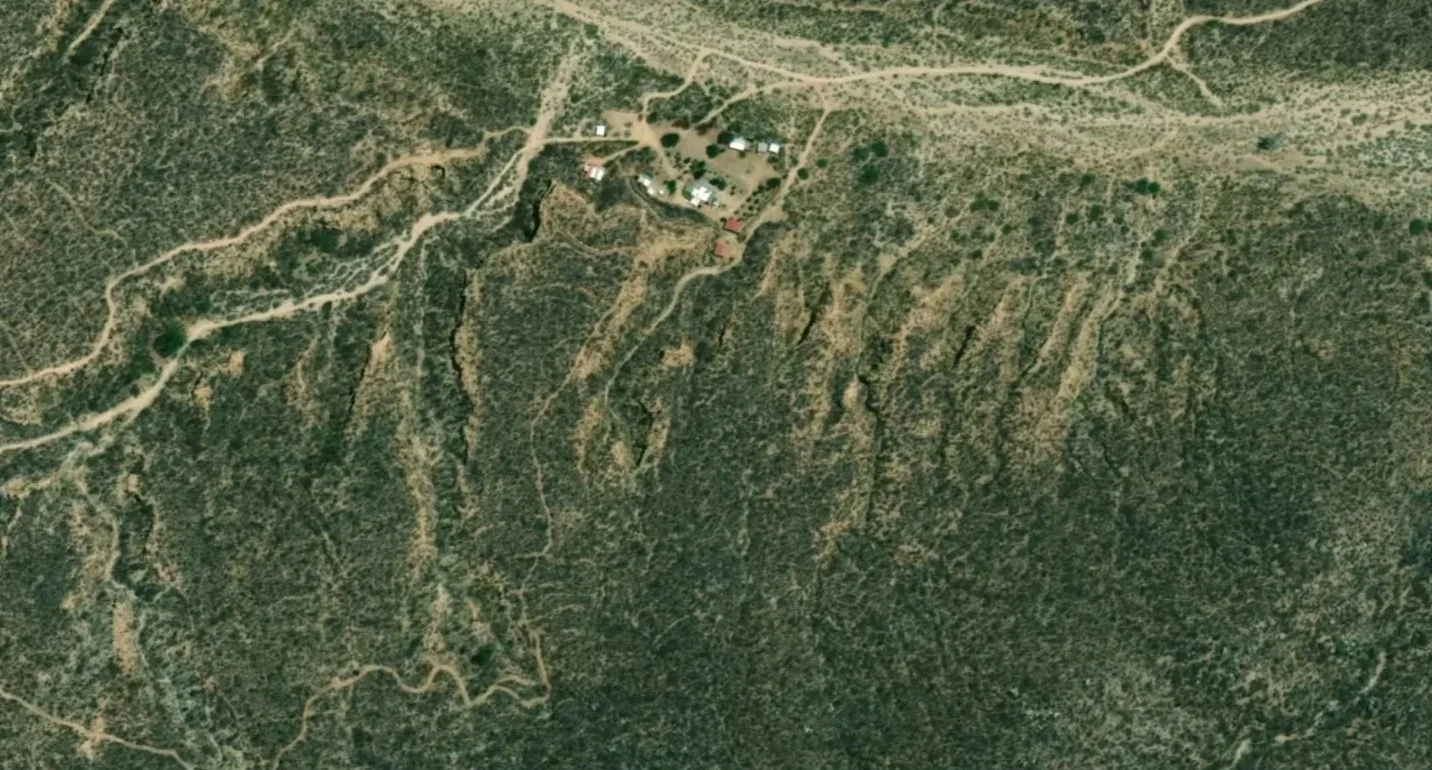
Rancho La Piedra, San Bartolo Watershed, Baja California Sur, México.
““We drain our communities by diverting rainwater away from rather than infiltrating it into our landscapes, waterways, and aquifers. We replace living nets of pervious vegetation and topsoil with impervious asphalt, concrete, and buildings, inducing rainwater to rush across the land and drain out of the system.””
education to action - changing the paradigm
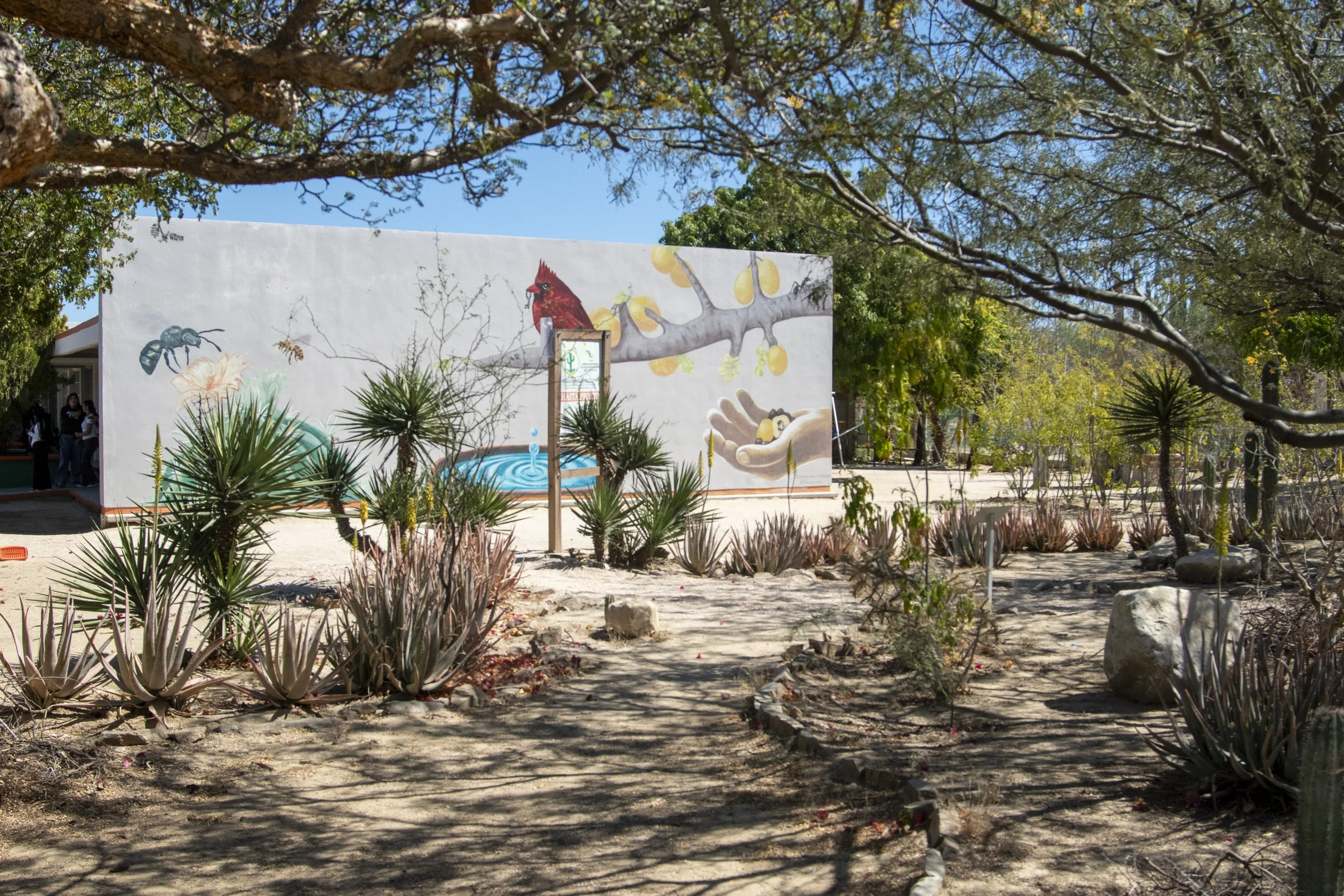
Aula viva (Living classroom) built at CECyT Los Planes 09 in BCS in 2005.
BCI has developed lesson plans and workshops that provide step by step tools to create micro watersheds in home gardens and school yards, focusing on native, drought-resistant plants and some of them associated with food crops such as tomatoes, beans, and squash.
Along with planting water in gardens, another step in BCI’s student water conservation program includes the alliance with the Salvemos el Encino Arroyero program, led by Daniel Perez, whose mission is to plant Quercus brandegeei, drought-resistant peninsular oak trees native to Baja California peninsula that are in danger of extinction. Known for their ability to withstand drought, these oak trees provide shade and food in the form of acorns.
“We are working with 895 high school students across the region,” Godoy Aguilar explains. “The students register where they plant the oaks at home and school and monitor their growth. These trees provide shade and stabilize soil during heavy downpours in the rainy season. Maybe most important, their root systems reduce erosion and help retain moisture.”
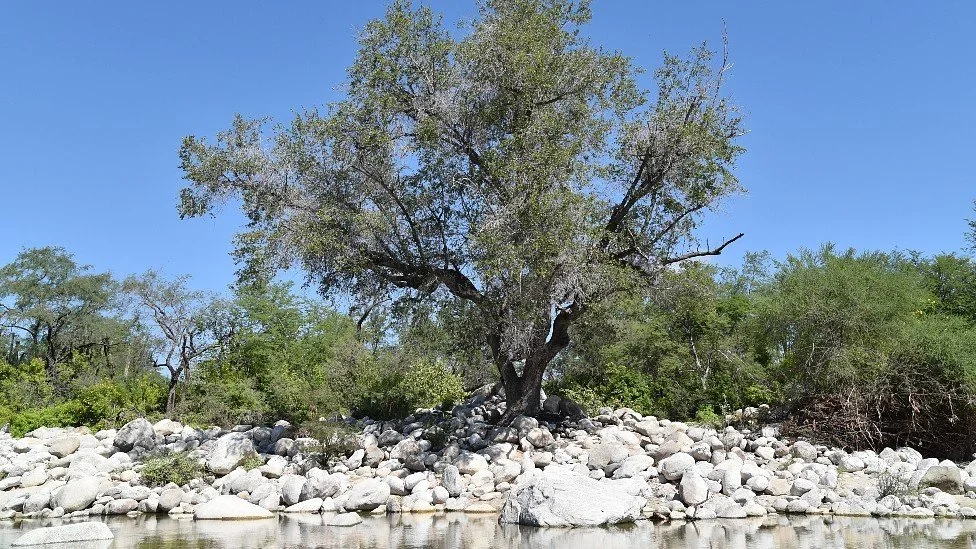
Encino arroyero (Quercus brandegeei)
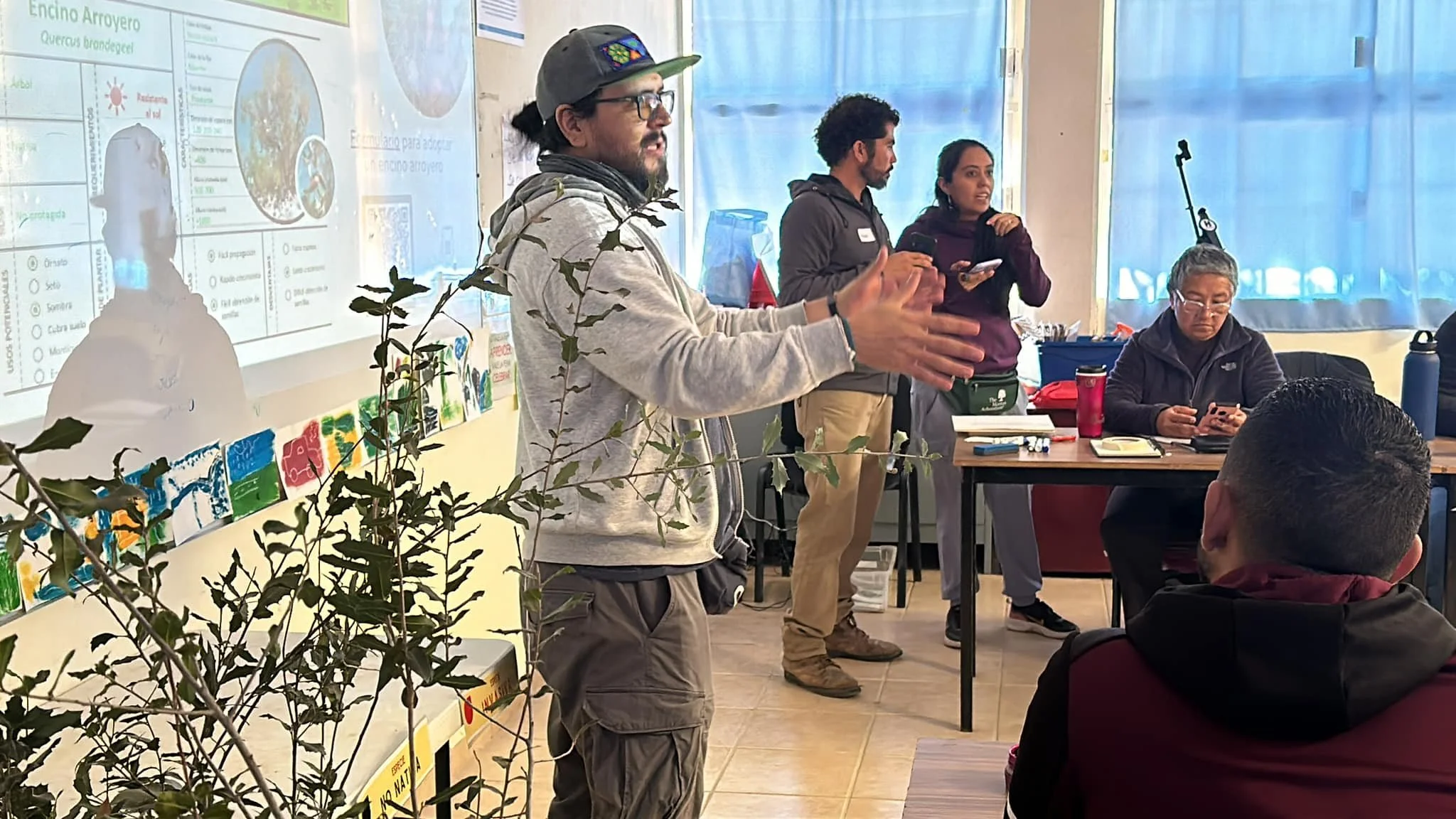
Daniel Pérez with Rogelio Cadena from Rancho La Piedra and BCI´s Team, at a school workshop to adopt, plant and care for Quercus brandegeei trees.
This is where BCI in partnership with Rancho La Piedra is changing the paradigm. The experience and support from the Ranch has served to BCI lesson plans and workshops that give step by step tools to create micro watersheds in home gardens and school yards. Coupled with hands-on training at the ranch, and observation of what works and what doesn’t at their schools, the students aim to become educators and ambassadors themselves.
Water Recapture Systems
Imagine this: The rainy season has begun. Storm clouds darken the western sky as they move east over the Sierra La Lagunas. The weather report has promised rain and it comes tapping on the roof before it turns into a late-summer deluge, running from gutters onto dry and desiccated yards where it flows into the street in rough channels gathering debris. Every year the rain floods roads, washing them out, cutting off small towns and communities.
Most families capture none of this water that could be used to maintain their gardens and keep their soil from eroding. Instead, they rely on water through a municipal system or delivered by trucks. Rarely do they consider building gabions or digging a cistern connected with the roofs.
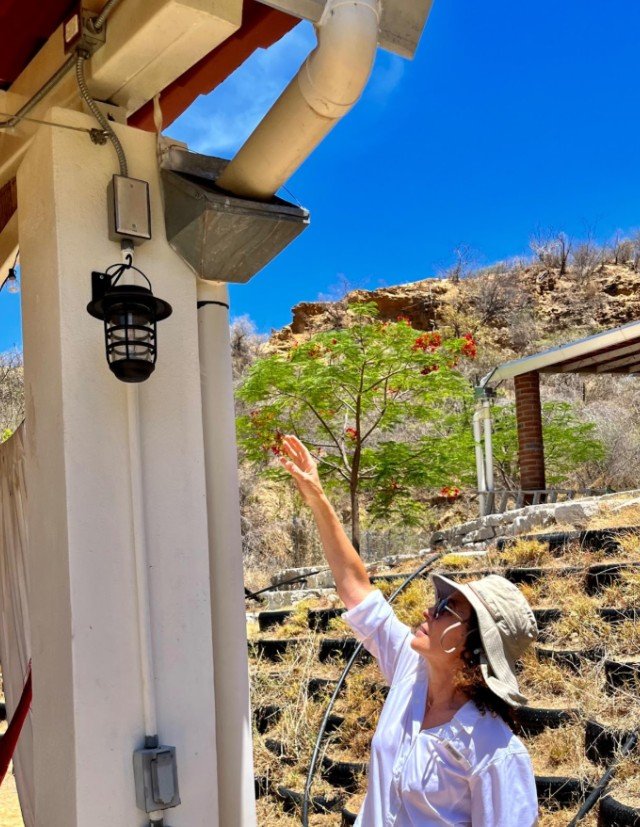
Water Capture System at the Side of Robinson Bours’ Outdoor Pavilion Above the Ranch’s Cistern.
Cisterns are a workable solution as well as diverting runoff to gardens. But families don’t have the resources to buy cisterns.
“With modest municipal investment,” Robinson Bours says, “communities could install cisterns that save money long term. The path forward is education. Once people understand how cisterns work, they want them because they can also save money.”
We stand at the edge of a pavilion beneath a corrugated metal roof lined with gutters. Metal drainpipes at the corners descend from the gutters into a cistern dug into the earth. A funnel with two mesh filters, one finer than the next, removes debris before water enters the system.
Underground pipes connect runoff from a guest house on the ranch that filters into the cistern.
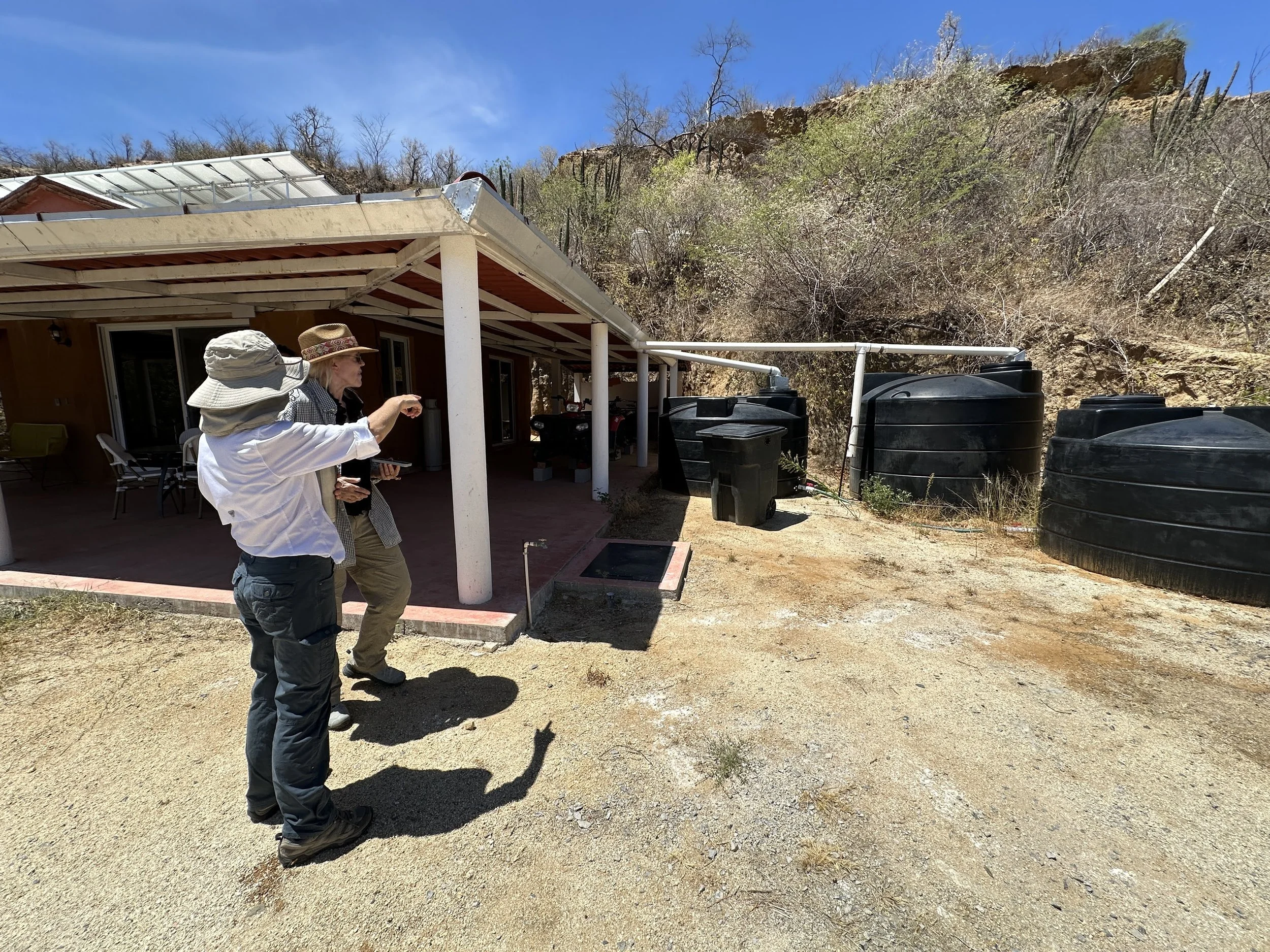
Monica Robinson explaining their water storage system at Rancho La Piedra
“With this system, we can fully water our fruit trees,” Robinson Bours says, "In a drought situation, you’re able to keep your trees going and provide food for your family, and maybe your community.”
“How much does it cost to set up a system?” asks Godoy Aguilar who shares that the roofs at the high school in Los Planes are expansive and would be ideal for collecting rainwater.
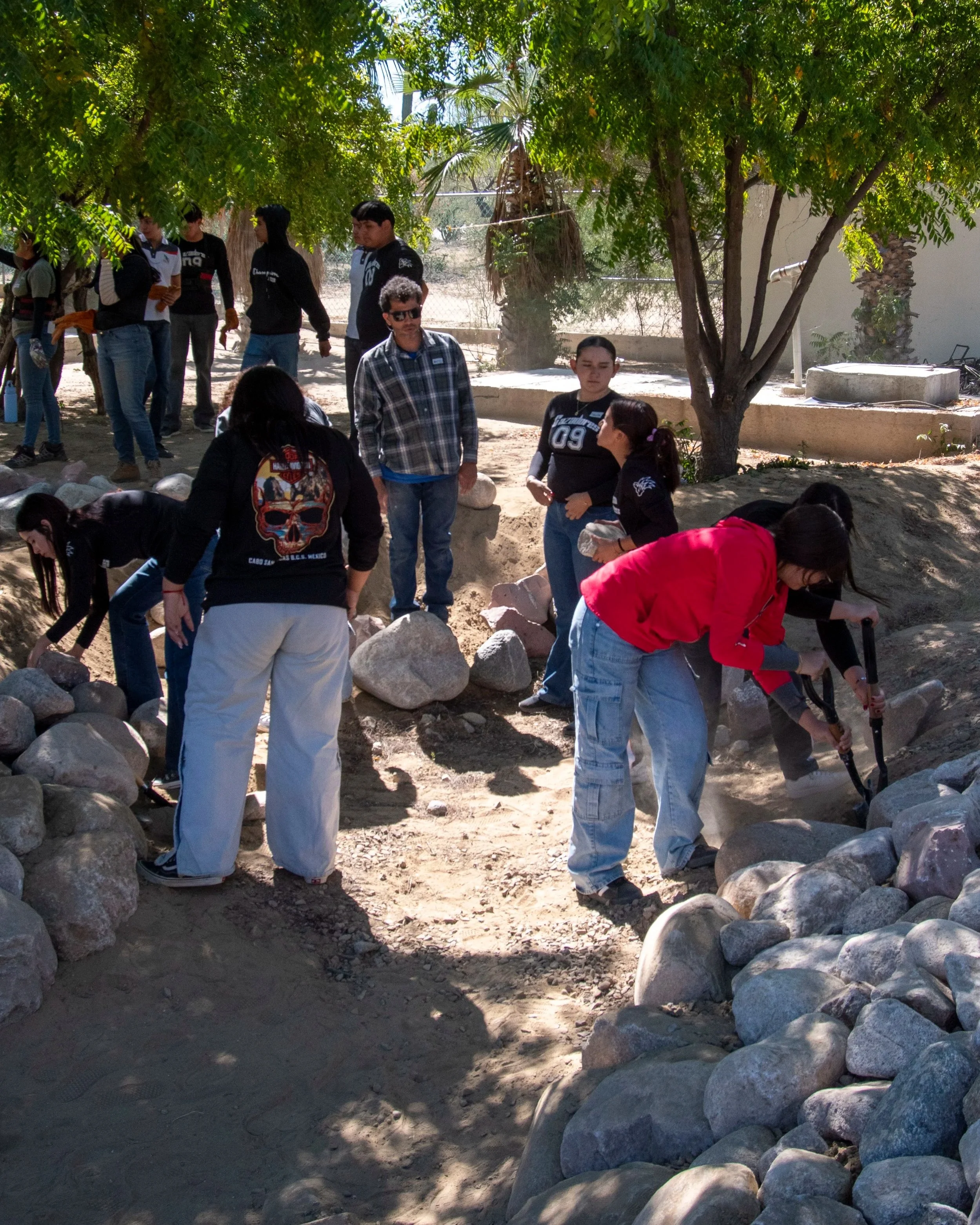
Students at Los Planes High School Lay Stones for the High School’s Water Recapture System
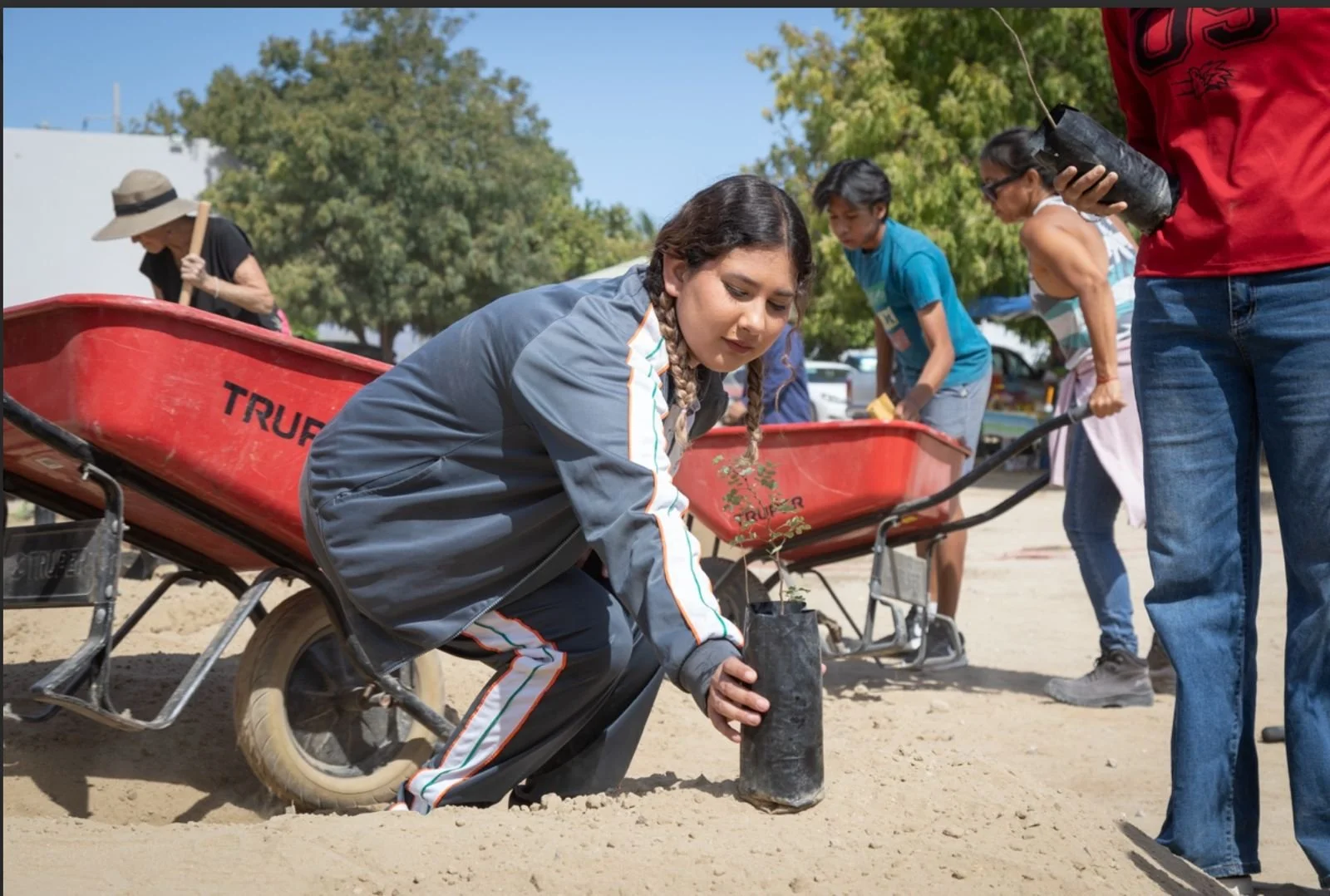
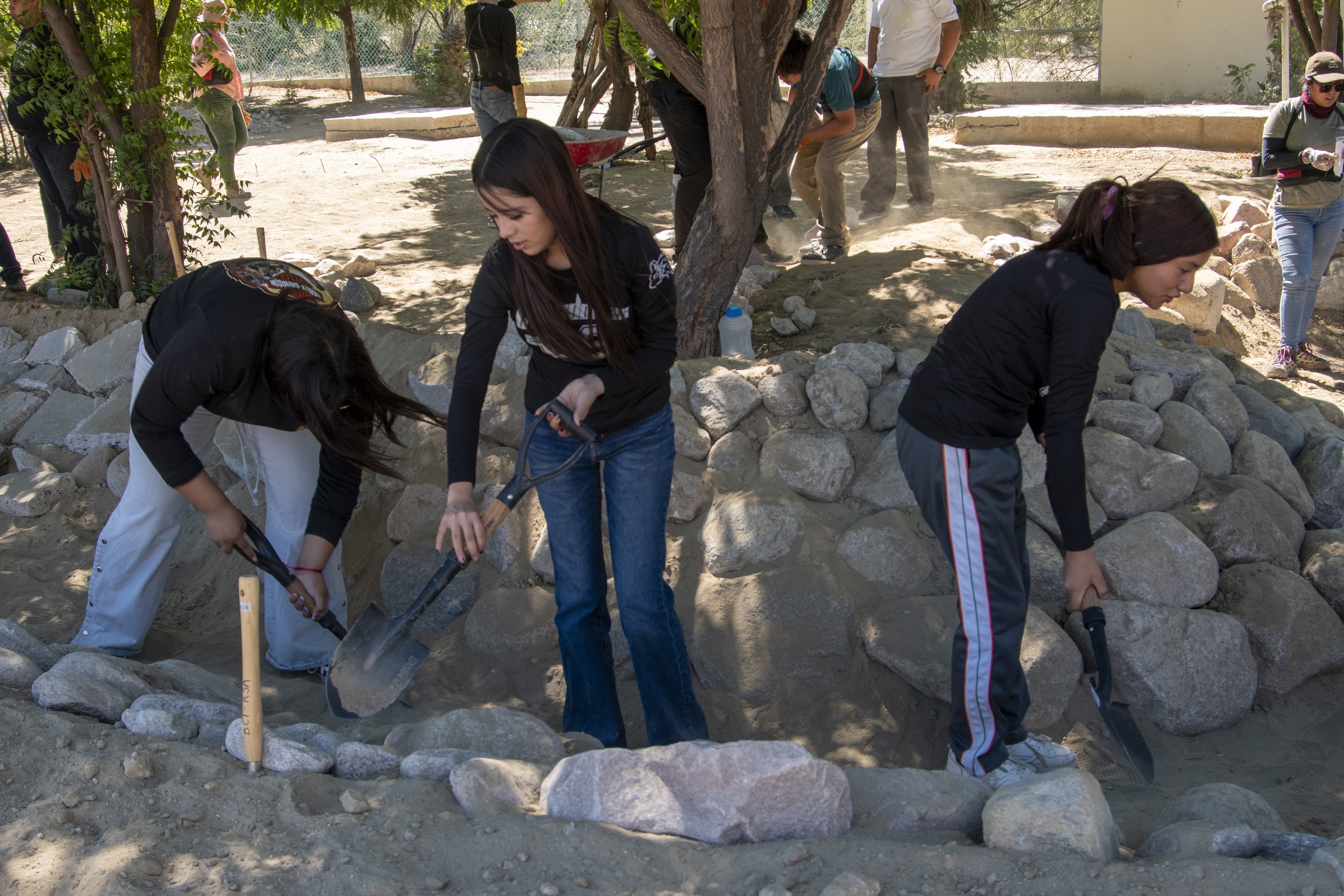
“For a community like Los Planes High School,” Robinson Bours says thoughtfully. “It's an investment, of course. But you’re educating young people to see their community differently. They become decision-makers in conserving resources.”
“It takes planning and patience,” she adds. “Over time, trees you plant will provide shade and through respiration lower the levels of carbon dioxide in the air, as well as the temperature, not to mention that the fruit itself can be eaten right away or preserved.”
The ranch itself has five rainwater harvesting and storage infrastructures with key line channels serving the ranch for a total of 521,500 Liters (130,375 gallons) of rainwater harvested per year. “We dig Key lines or contour line channels into the soil to guide water to flow where it’s needed,” she explains.
Coastal areas in Baja Sur typically receive 100 to 200 millimeters (4 to 8 inches) of rain per year. Inland areas may receive slightly more, 200 to 300 millimeters (8 to 12 inches) annually. And the mountains where Rancho La Piedra is located can receive up to 400 millimeters (16 inches) per year. Most of that water becomes run-off or disappears quickly through evaporation. ( 2)

Roadrunner Mosaic Marking the Center of Robinson Bours’ Pavilion Cistern
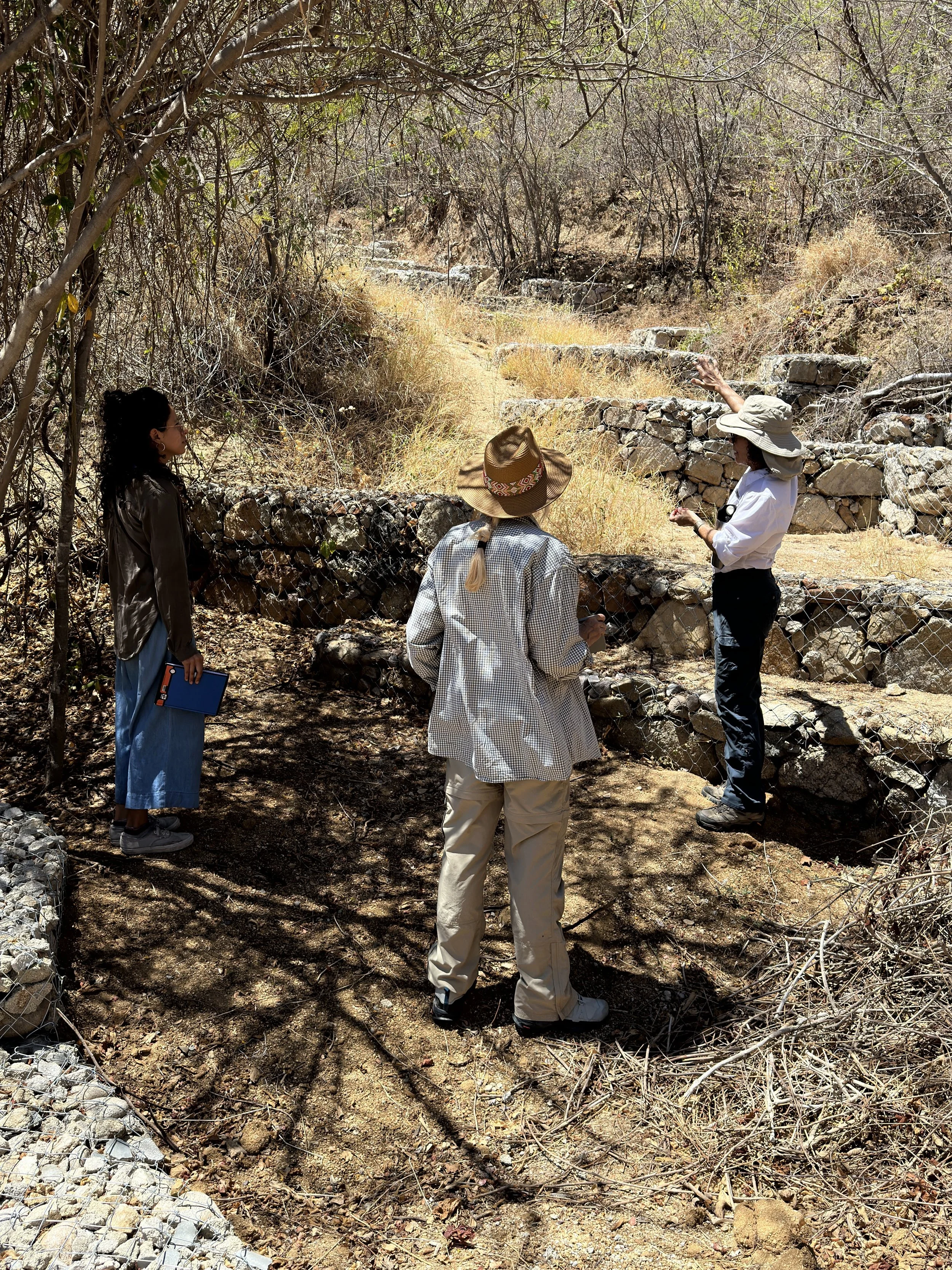
Maximizing Water Flow with Stone Gabions; Frida Sanchez Luna, Joy Stocke, Monica Robinson Bours
“What you see here at the ranch is part of an ecosystem that has been sixteen years in the making,” Robinson Bours explains. “We watched where the water flows, where it stops, where erosion occurs, what happens during dry periods.”
Robinson Bours also sought out experts and experienced practitioners of water conservation. One of those is Brad Lancaster, a pioneer in water conservation who put all the methods Robinson Bours uses into practice on a small suburban property in Arizona and has become an expert in harvesting water in desert environments.
Lancaster’s book, Rainwater Harvesting for Drylands––Volume 1: Guiding Principles to Welcome Rain into Your Life and Landscape––has become a primer, a tool, and an indispensable textbook ( 2).
“Brad was one of our first teachers and gave me the idea of doing things very simply,” she says. “As you have demonstrated, what we’ve learned can be taught and replicated on a small lot or in a schoolyard.”
Dry Toilets Not Only Save Water, They Provide Compost that Improves Soil
Fact: A person who uses a toilet with water consumes in one year the amount of water they could drink in more than 40 years. Well-treated urine and composted waste provide important nutrients for the soil. ( 2)
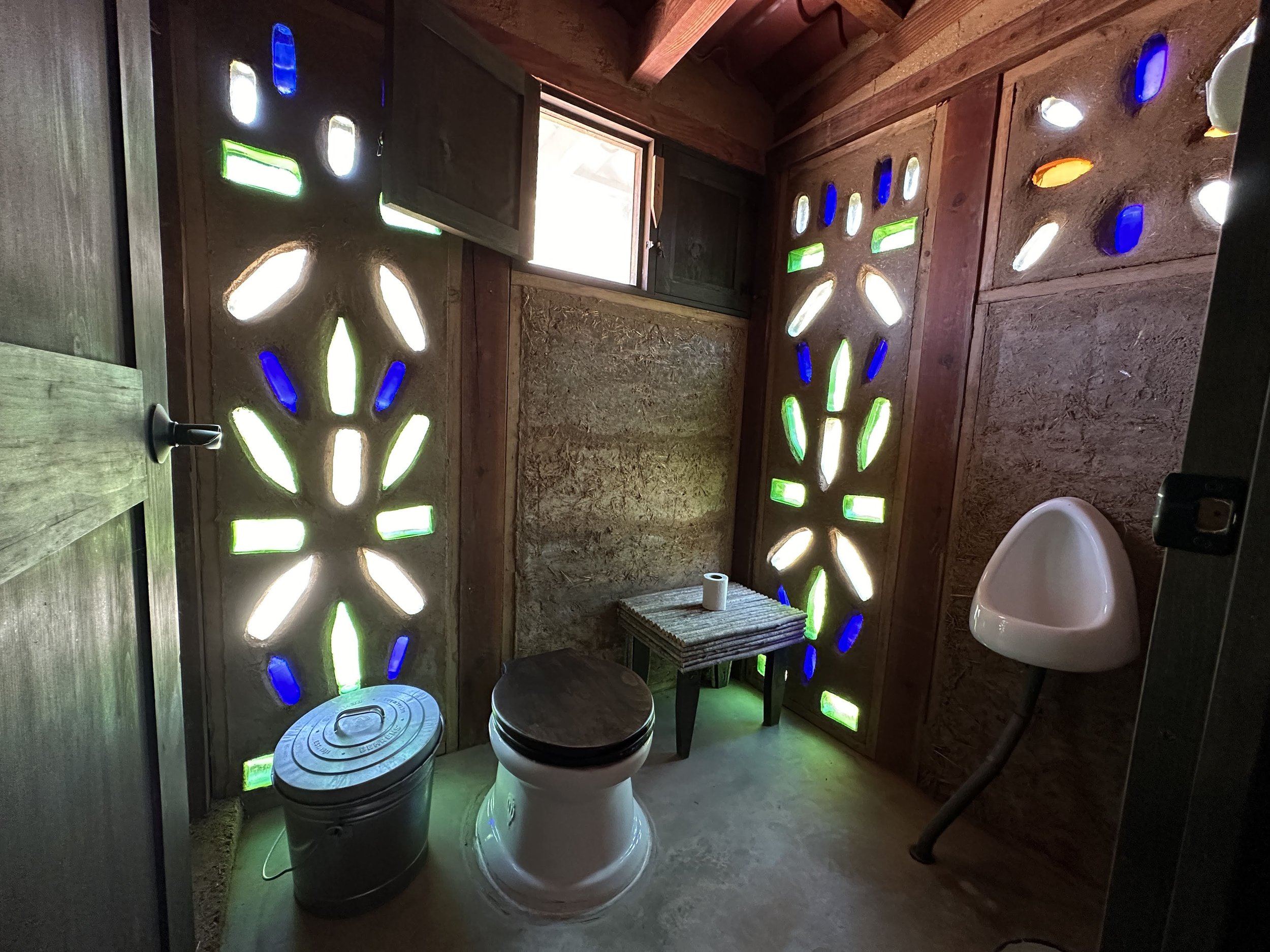
Composting Toilet/Rancho La Piedra
We enter a room whose adobe walls glow with light streaming through recycled, colored glass bottles that have been incorporated into the exterior walls’ design. Against the far wall is a toilet. Next to the toilet stands a metal bucket holding dried, herbaceous-smelling straw.
“From the beginning, we knew we would have composting toilets. Most of us don’t like to talk about it,” Robinson Bours says, “but a flushing a toilet uses more water than any other activity. On an average day a family uses 72 liters (19 gallons) just to flush toilets ( 2). Imagine the amount of water usage in a 1000 room resort. We simply don’t have enough water in our aquifers to sustain that kind of usage.”
The room smells pleasantly like a field in summer. Robinson Bours explains that the use of straw creates heat and breaks down quickly, accelerating the composting process. As for urine, there is a funnel through the wall which deposits it into a container.
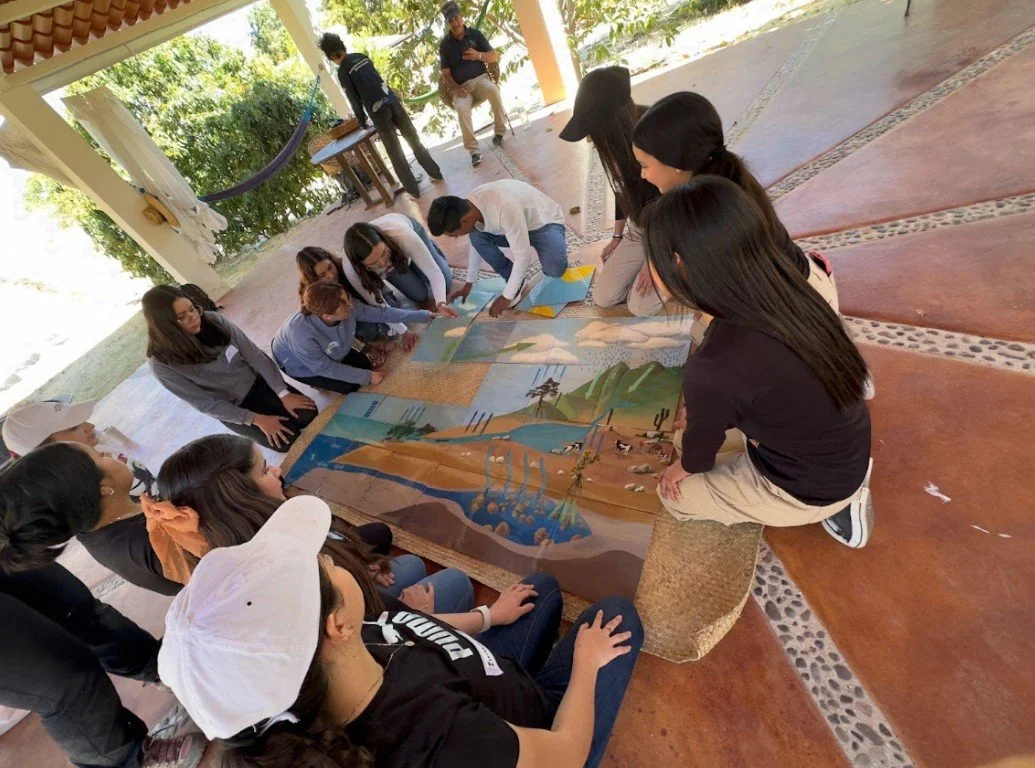
Students attending a workshop at Rancho La Piedra
“We can teach anyone this system,” Robinson Bours says. “It’s something students like to learn and I find young people adapt to it quickly. The best part is that there are many ways to adapt it to your own environment.”
As we walk back to the main house for lunch, we ask Bours how much water the ranch uses from its wells.
“We’ve assessed which areas truly require using water from the aquifer. We use it for drinking and bathing, as well as for washing dishes and clothes, drawing it from one of our wells,” she explains. “For all of us, it is clear that water is not only a resource at risk, it is also costly. What would happen if we learned—if not completely, then at least to a large extent—to become more independent from the water supply network?”
We return to the subject of the region’s aquifers and how to coexist with them so that we create an equilibrium between water that we use and water that flows back to/or recharges those aquifers.
“Since we’re all part of the desert ecosystem, we need to manage our water use in concert with rainfall and water recapture to allow the aquifer to recharge,” says Robinson Bours. “The challenge comes when we multiply that use by 100,000 people in a desert region that simply doesn’t have enough water. If the water in our aquifers is at least many thousand years old and it can be depleted in fifty years, we have a problem, so let’s put solutions in place now. “
Back at the main house, Robinson Bours returns with an earthenware bowl piled high with fresh lychees.
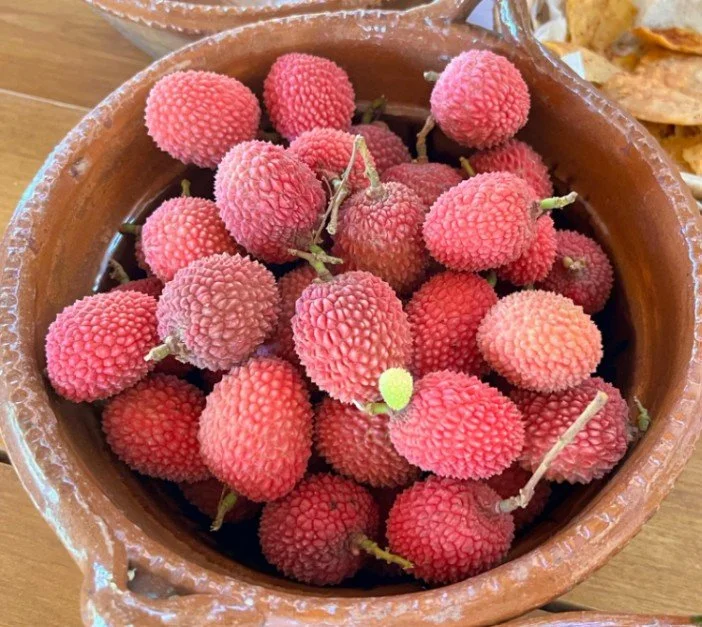
Lychee Fruit Grown with Water harvested from the Cistern
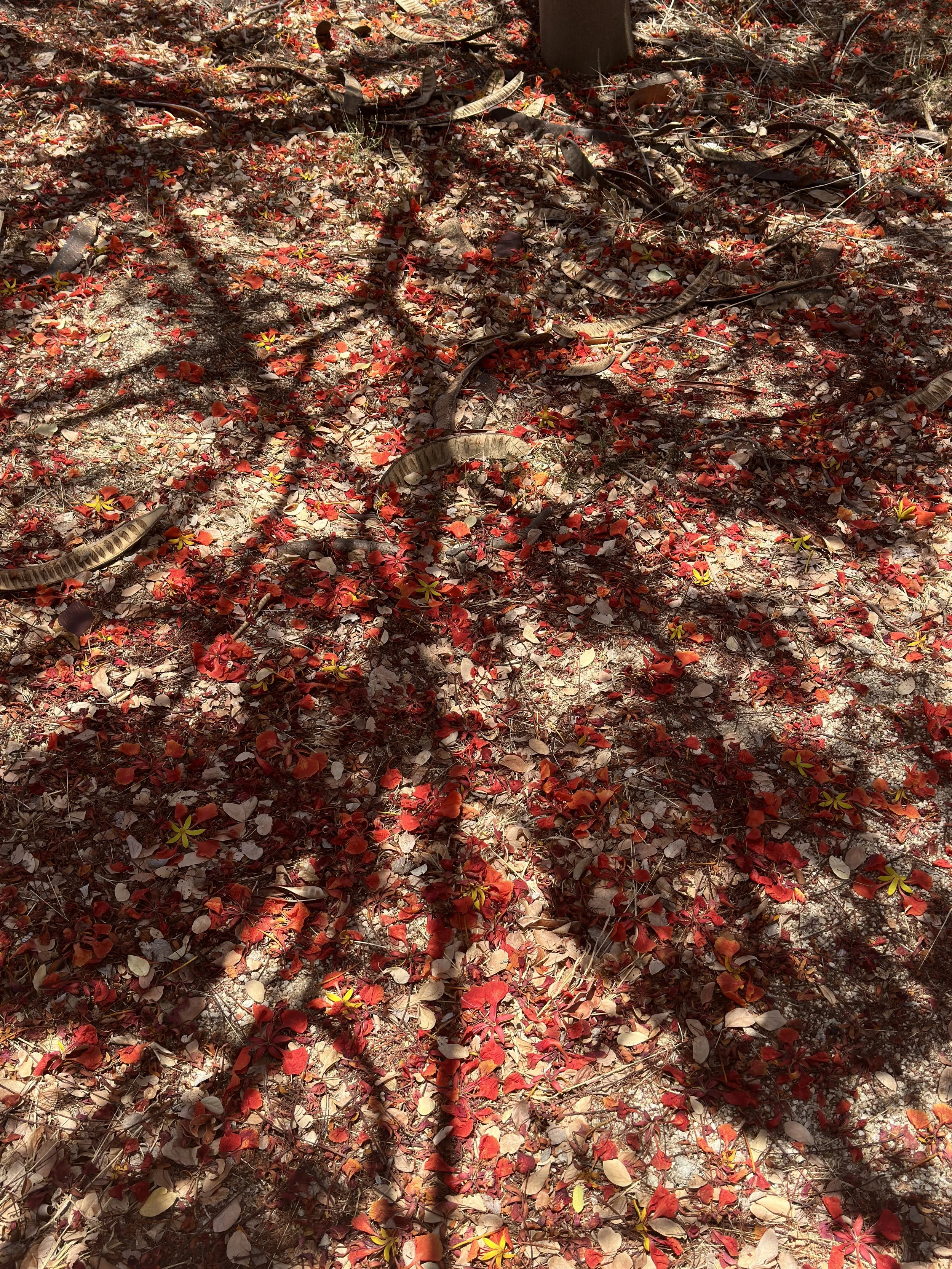
Leaves Becoming Compost
“Everything we do here at Rancho La Piedra is because we’re a living laboratory,” she says. “All of this has been done, as I said, for thousands of years. None of this is new. We’re simply showing that it can be taught and learned.”
Godoy Aguilar nods. She and Sanchez Luna will bring their students for training in the coming weeks. “But we reuse that water too,” adds Robinson Bours, “through a drip irrigation system that waters our plants and herbs in the terraces in front of the main house. In that way, water performs two tasks.”
Godoy Aguilar and Sanchez Luna share how the curriculum co-developed with the local high school teachers is now used by four schools in the region. “The students are already reimagining a home where young people like themselves recognize more birds than brand logos,” says Godoy Aguilar, “where ancestral knowledge of native plants is not only preserved but honored and passed on with pride.”
“You and your students are learning alongside us,” Robinson Bours adds. “We have the opportunity to take small steps in our communities. That is how we can make an impact. And one day, I’m sure, the students will teach others.”
For more information about the Baja Coastal Institute, Rancho La Piedra, and the Education to Action program, click here.
Joy E. Stocke has been visiting and writing about Baja California Sur and its resources for more than twenty years.
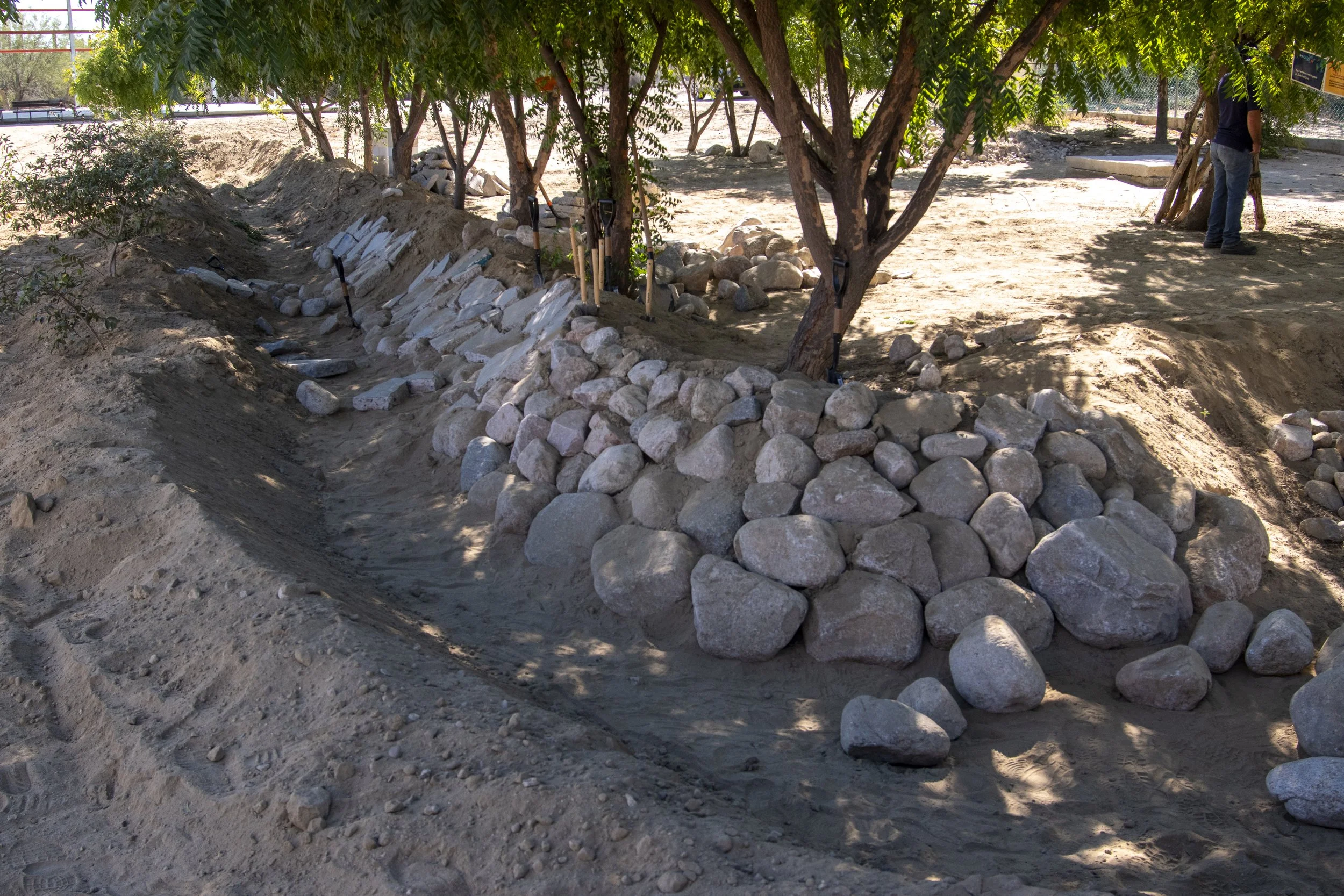
Stone Gabbion - Los Planes High School
References
Water on the Eastern Cape, Baja California Sur, México. Watersheds of Los Planes, San Bartolo, Santiago y Cabo Pulmo by BCI / Baja Coastal Institute and Legacy Works Group (2021) View the full report here.
Rainwater Harvesting for Drylands and Beyond by Brad Lancaster. Click to visit www.harvestingrainwater.com